


The Health Desk
Advertorial
The “Clean” Nicotine Habit Isn’t So Clean: What Pouches Are Doing to Your Mouth, Your Heart and Your Mornings
No smoke, no spit, no smell. Nicotine pouches were sold as the tidy way to get a hit, and sales have exploded. We went through the FDA’s own statements and the published research and found a picture that is a lot less tidy. We also looked at why some users are now switching to pouches with no nicotine in them at all.

By Claire Whitcombe · Health Reporter

How a pouch went mainstream
Not long ago, nicotine pouches were a niche product. Now the small round cans are stacked by the register at gas stations, tucked into gym bags and passed around on job sites. It’s easy to see the appeal. There is no smoke, no spit cup and no smell on your clothes. You tuck a pouch under your lip, and nobody in the meeting knows it’s there.
The sales figures show how fast the habit has spread. A study of U.S. retail data found that monthly pouch sales climbed from 327 million pouches in July 2021 to 1.05 billion in May 2024, more than tripling in under three years.1
Nicotine pouches sold in the U.S. each month
Individual pouches, retail sales
July 2021 vs. May 2024. Source: He et al., Tobacco Control, 2025.
Teenagers noticed too. In the 2024 National Youth Tobacco Survey, 1.8% of U.S. middle and high school students, about 480,000 kids, said they had used nicotine pouches in the past 30 days.2 The 2025 survey put the figure at 1.7%.3
Younger children are getting into the cans as well. The rate of young children swallowing nicotine pouches rose 763% from 2020 to 2023, according to a study in Pediatrics, and pouches were more likely than other nicotine products to lead to a serious medical outcome.4 The FDA has warned that toxic effects in kids can occur at nicotine doses as low as 1 to 4 milligrams.5
The same thing that makes pouches easy to use makes them easy to overuse. A habit nobody can see is a habit nobody comments on, and it doesn’t take long for one pouch after lunch to turn into one every hour.
“Tobacco-free” doesn’t mean nicotine-free
Plenty of pouch brands point out that there’s no tobacco leaf inside. That’s true, and it’s also beside the point. The active ingredient is nicotine, either extracted from tobacco or made in a lab, and the CDC says there is little chemical difference between the two.7
“Nicotine pouches contain nicotine, which is highly addictive, and can deliver harmful chemicals.”
U.S. Food and Drug Administration6
Strength varies, and it’s going up. The pouches the FDA has authorized range from 2 mg to 11 mg of nicotine each, after the agency cleared 9 mg and 11 mg versions of Zyn in August 2026.8
In January 2025, the FDA authorized the sale of 20 Zyn products. The agency was careful about what that decision means. In its own words, “it does not mean these tobacco products are safe, nor are they ‘FDA approved.’”9

What researchers are finding in users’ mouths
A pouch doesn’t move around. It sits in one spot against the gum for long stretches, several times a day, often in the same place every time. Dental researchers have started documenting what users are dealing with.
48%of pouch users in a Johns Hopkins survey reported mouth lesions
37%reported a sore mouth
79%of young pouch users examined in Stockholm had oral lesions
When Johns Hopkins researchers surveyed 118 American adults who use nicotine pouches, 48% said they had experienced mouth lesions and 37% a sore mouth. Many also reported an upset stomach. The survey relied on users’ own reports, and many of them smoked as well.10
Dentists in Stockholm went further and examined people directly. Among 126 pouch users aged 18 to 30, they found oral lesions in 79%.11
The first pouch of the day

Clinicians use a simple question to gauge how dependent someone is on nicotine: how soon after waking do you use it? The sooner that first dose, the stronger the dependence tends to be.12 On a version of that test built for smokeless products, the pouch users in the Johns Hopkins survey scored at significant levels of dependence.10
Going without has a cost. The National Institute on Drug Abuse lists irritability, craving, anxiety and trouble with attention among the symptoms of nicotine withdrawal, and says they can start within hours of the last dose.13
“I started waking up in the morning feeling really jittery until I put a pouch in my mouth. I don’t like the feeling of physical addiction.”
Kristi L., who used nicotine pouches every day, in a review she posted on Flow’s website
Nicotine also works on the heart. The U.S. Surgeon General’s report notes that it increases heart rate.14 What years of daily pouch use mean for the heart is still an open question: in 2025, the American Heart Association said the long-term data simply don’t exist yet.15
None of this makes a pouch as dangerous as a cigarette. In June 2026, the FDA allowed Zyn to tell adults that using its pouches instead of cigarettes lowers the risk of diseases including mouth cancer, heart disease and stroke.16 But that is a comparison with smoking, and “less harmful than cigarettes” is a low bar. It is not the same thing as harmless.
Why “just stop” is harder than it sounds
Read enough user reviews and a pattern shows up. People don’t only miss the nicotine. They miss the feel of the pouch in their lip, the flavor, the little break in the afternoon, the thing they do on the drive home.
“I miss the lip feel and the habit.”
Dustin V., who went from dip to Zyn before trying a nicotine-free pouch
That’s why going cold turkey can feel like losing two things at once: the nicotine and the routine built around it. It’s also the gap a newer kind of pouch is built to fill. Same can. Same spot under the lip. No nicotine inside.
The nicotine-free pouch building a following: Flow
One brand in this new category is Flow, a Texas company that makes its pouches with functional mushrooms instead of nicotine. The company says it has sold more than one million cans.
The founders say they started on the idea after watching friends and family lean harder on nicotine pouches just to get through the day. As the company tells it, the options were nicotine for focus, caffeine for energy or supplements that never worked, and every one came with a crash, a dependency or both. They were, in Flow’s words, “tired of the trade-off.” So they set out to make a pouch that keeps the ritual and leaves the nicotine out.
A can of Flow looks like the cans it replaces. There are 20 pouches inside, flavors like Wintergreen and Cool Mint, and each pouch goes under your lip the same way. Flow’s product page says it kicks in within about five minutes and lasts three to four hours.

We read the label. Here’s what’s in a Flow pouch
Plenty of supplement brands hide their doses behind a “proprietary blend.” Flow publishes its full label, so we went through it line by line.
Supplement Facts
Serving size: 4 to 6 pouches per day
Servings per container: 4 to 5
| Per pouch | Amount | % DV |
|---|---|---|
| Lion’s Mane (Hericium erinaceus 10:1 extract) | 30 mg | ** |
| Cordyceps (Cordyceps militaris 10:1 extract) | 15 mg | ** |
| Reishi (Ganoderma lucidum 10:1 extract) | 15 mg | ** |
| Theacrine | 15 mg | ** |
| Vitamin B12 (methylcobalamin) | 20 mcg | 833% |
| Allulose (natural sweetener) | 100 mg | ** |
| Glycerol (vegetable glycerin) | 50 mg | ** |
Other ingredients: natural flavor, microcrystalline cellulose, sodium chloride.
** Daily Value not established. Transcribed from the supplement label on Flow’s product page, September 2026.
One detail is worth knowing. The mushrooms are 10:1 extracts, so the 30 mg of Lion’s Mane in each pouch is concentrated from about 300 mg of mushroom. That’s where the “600mg mushroom blend” on the can comes from: 300 mg of Lion’s Mane, 150 mg of Cordyceps and 150 mg of Reishi, counted as whole mushroom.
 Lion’s ManeAn edible mushroom studied for its role in supporting memory and focus.
 CordycepsTraditionally used to support energy and stamina.
 ReishiAn adaptogen long used to support a balanced response to everyday stress.
 TheacrineA compound found in a Chinese tea plant. Flow calls it caffeine’s “calmer cousin.”
 Vitamin B12Supports normal energy metabolism.
 AlluloseA low-calorie sweetener used in place of sugar.
Just as important is what isn’t on the label.
- No nicotine
- No caffeine
- No sugar
- No sucralose or aspartame
Flow says its pouches are made in FDA-registered facilities and are third-party lab tested.17
Flow vs. nicotine pouch
| Flow | Nicotine pouch | |
|---|---|---|
| Nicotine | None | Yes (2 to 11 mg per pouch in FDA-authorized products) |
| Addictive ingredient | No nicotine | Nicotine, which the FDA calls addictive |
| What’s doing the work | Lion’s Mane, Cordyceps, Reishi, theacrine, vitamin B12 | Nicotine |
| Under-the-lip ritual | Yes | Yes |
| Pouches per can | 20 | 15 in a can of Zyn |
What people who switched are saying
★★★★★
“I’ve definitely found my nicotine pouch replacement”
I was using nicotine pouches every day… I don’t like the feeling of physical addiction, so I’ve been trying to find a replacement. Both the Blue Razz and the Citrus are just pure fruity/sweet flavors… I have been AMAZED at how long the flavor lasts!!
Kristi L. Aug. 2026
 ★★★★★
★★★★★
“No jitters, no burn”
It’s great on its own. No jitters, no burn. Impressed so far. Cool Mint.
Anthony E. Aug. 2026
★★★★★
“They satisfy the ritual”
While these definitely don’t pack a punch like nicotine, they really do satisfy the ritual and oral fixation that pouches give you. The flavors are pleasant, and they even have a slight cooling effect.
G.P., who used 6 to 7 Zyn pouches a day July 2025
 ★★★★★
★★★★★
“Strong and full of flavor”
I love the strong taste of it. Stronger the better.
Kevin A. · Verified buyer Wintergreen
★★★★★
“The best alternative out there”
Copenhagen to Zyn… but I miss the lip feel and the habit. Flow tastes great and satisfies my itch. Great customer service, definitely the best alternative out there.
Dustin V. · Verified buyer Wintergreen
★★★★★
“Soft and comfortable in the lip”
Flavor is nice, the pouch is “soft” and comfortable in the lip compared to other tobacco pouches.
Travis L. · Verified buyer Blue Razz
If you want to try it
Flow sells direct from its website. If you use mint pouches now, Wintergreen or Cool Mint is the closest match. If you prefer fruit, there’s Citrus, Blue Razz and Sour Apple, or a Variety Pack if you want to try them all.
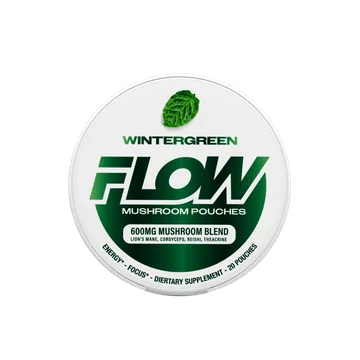 Wintergreen
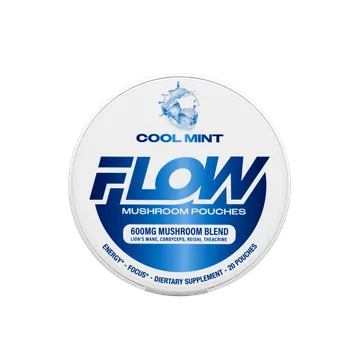 Cool Mint
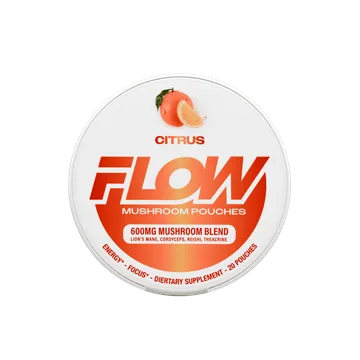 Citrus
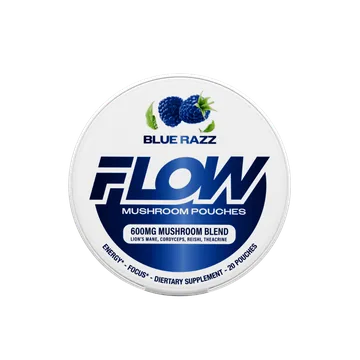 Blue Razz
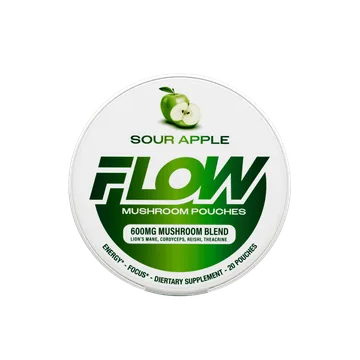 Sour Apple
Use it where your pouch usually goes. The label suggests 4 to 6 pouches a day, and Flow says most people feel the full effect after about a week of daily use.
At the time of writing, Flow is running a Buy 4, Get 4 Free offer. It also offers a 60-day money-back guarantee to customers who use the pouches consistently for at least two weeks.17
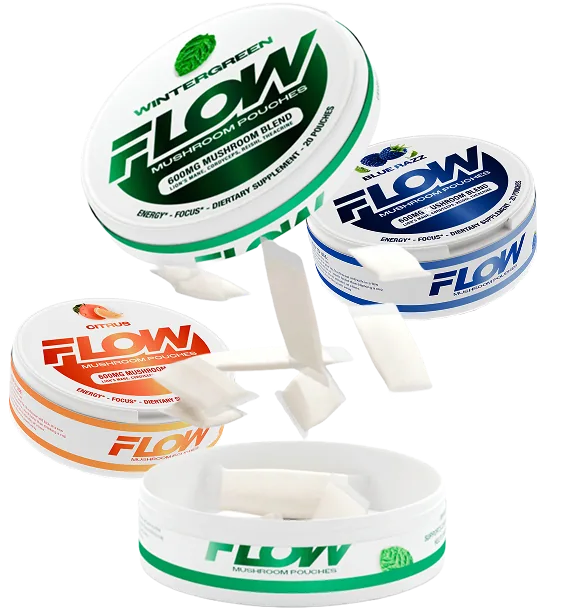
Current offer
Try Flow, the pouch with no nicotine
Buy 4 cans, get 4 free
Offer shown on Flow’s website at the time of writing.
- 0 mg nicotine, no caffeine, no sugar
- Lion’s Mane, Cordyceps, Reishi and theacrine
- 20 pouches per can, 5 flavors
- Third-party lab tested, according to Flow
- 60-day money-back guarantee (terms apply)
Secure checkout
Pause or cancel anytime
60-day guarantee
Questions readers ask
Does Flow contain nicotine or caffeine?
No. Flow’s label lists no nicotine and no caffeine. The active ingredients are Lion’s Mane, Cordyceps and Reishi mushroom extracts, theacrine and vitamin B12.
How fast does it work, and how long does it last?
Flow’s product page says most people feel it in about 5 minutes and that the effect lasts 3 to 4 hours, with each pouch kept in for 20 to 30 minutes.
How many pouches should I use a day?
The label lists a serving of 4 to 6 pouches per day. Each can holds 20 pouches, which Flow says lasts most people about a week.
What does it taste like?
There are five flavors: Wintergreen, Cool Mint, Citrus, Blue Razz and Sour Apple, plus a Variety Pack. Flow is sweetened with allulose and contains no sucralose or aspartame.
Is Flow a quit-nicotine product?
No. Flow is a dietary supplement, not a nicotine replacement therapy, and it is not intended to treat nicotine dependence. Many customers use it in place of nicotine pouches because it keeps the same ritual. If you want help quitting nicotine, talk to your doctor or call 1-800-QUIT-NOW.
What if it isn’t for me?
Flow offers a 60-day money-back guarantee. To qualify, the company asks that you use Flow consistently (4 to 6 pouches a day for at least two weeks). Check the full terms and the return policy on Flow’s website before you order.
How is Flow made and tested?
Flow is based in Austin, Texas. The company says its pouches are made in FDA-registered facilities and third-party lab tested. Note that FDA registration of a facility is not an FDA approval of the product.
Sources
- He Y, et al. Trends of oral nicotine pouch prices and sales by product characteristics in the USA, 2021-2024. Tobacco Control, 2025.
- Park-Lee E, et al. E-cigarette and nicotine pouch use among middle and high school students, United States, 2024. MMWR, 2024.
- U.S. Food and Drug Administration. National Youth Tobacco Survey, 2025 findings.
- Olivas M, et al. Nicotine ingestions among young children: 2010-2023. Pediatrics, 2025.
- U.S. Food and Drug Administration. Statement urging nicotine pouch makers to use child-resistant packaging, September 2025.
- U.S. Food and Drug Administration. Other tobacco products: nicotine pouches.
- Centers for Disease Control and Prevention. Nicotine pouches.
- U.S. Food and Drug Administration. Nicotine pouch products authorized by FDA, updated August 2026.
- U.S. Food and Drug Administration. FDA authorizes marketing of 20 ZYN nicotine pouch products after extensive scientific review, January 16, 2025.
- Dowd AN, et al. A cross-sectional survey on oral nicotine pouches: characterizing use-motives, topography, dependence levels, and adverse events. Nicotine & Tobacco Research, 2024.
- Daneshian M, et al. Oral lesions and dental status in individuals using oral tobacco-free nicotine pouches. Oral Diseases, 2026.
- Heatherton TF, et al. The Fagerström Test for Nicotine Dependence. British Journal of Addiction, 1991.
- National Institute on Drug Abuse. Is nicotine addictive?
- U.S. Department of Health and Human Services. The Health Consequences of Smoking: 50 Years of Progress. A Report of the Surgeon General, 2014.
- Dennison Himmelfarb CR, et al. Impact of smokeless oral nicotine products on cardiovascular disease: a policy statement from the American Heart Association. Circulation, 2025.
- U.S. Food and Drug Administration. Authorization of 20 ZYN nicotine pouches to be marketed with a modified risk claim, June 2026.
- Flow Pouch. Product page, supplement label and FAQ. flowpouch.com, accessed September 17, 2026.